Sleeves That Stop Short and Tops That Ride Up: Tall Fit Beyond Inseam
Quick Answer: Standard activewear is drafted for a 5’6” to 5’8” frame, and brands that offer tall sizing almost always extend the inseam only. That leaves two unfixed problems: sleeves ending above the wrist bone, and tops riding up when you reach overhead. Solve them by choosing thumbhole cuffs (which anchor length where it matters), longline or tunic-length tops rather than standard, raglan sleeves which have more built-in length, and by checking the shoulder-to-hem measurement rather than trusting a size label.

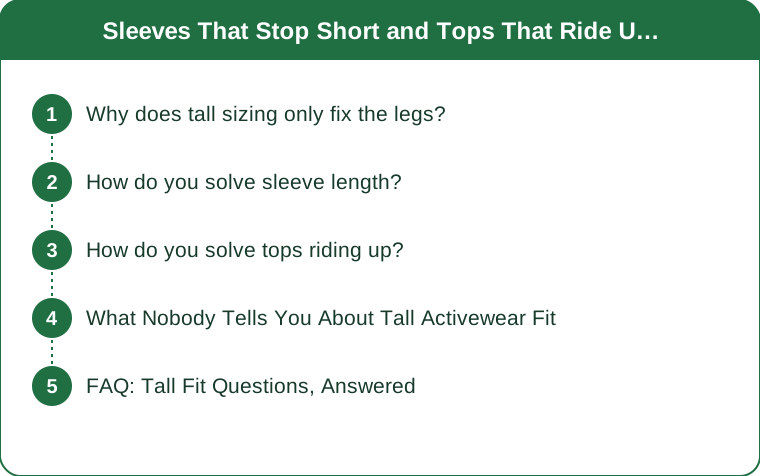
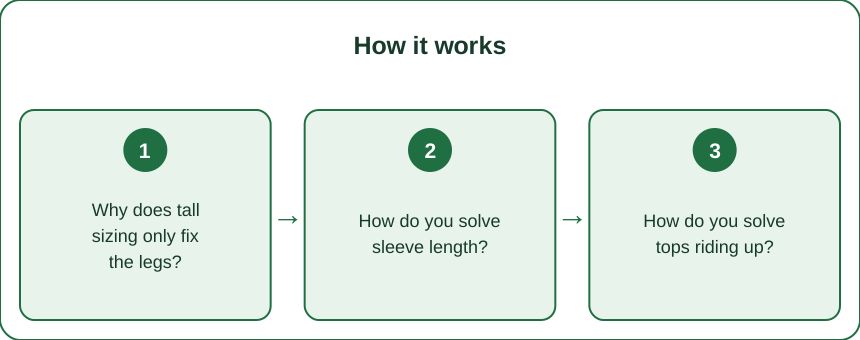
Why does tall sizing only fix the legs?
Because inseam is the cheapest dimension to change. Extending a leg pattern is a simple modification that reuses the same pattern pieces with a longer cut. Re-drafting a top means moving the armhole, the bust point, the shoulder slope, and the sleeve cap — a different pattern entirely.
So brands add a tall inseam option, mark the box as addressed, and leave the top half alone.
The result is that tall shoppers get a well-fitting bottom and keep buying tops that are wrong in two specific ways.
Sleeve length is drafted from a standard shoulder-to-wrist measurement. On a longer arm, the cuff lands above the wrist bone, which reads as a too-small garment even when the body fits perfectly.
Torso length is drafted from a standard shoulder-to-hem. On a longer torso, the hem sits higher, which is fine standing and becomes a problem the moment you reach overhead — the hem lifts and stays lifted.
Both are length problems in a dimension nobody is grading for. Sizing up gives you a wider garment with roughly the same length, which is why it never works.
How do you solve sleeve length?
Thumbholes are the most effective single feature. They anchor the cuff at the base of the thumb regardless of how the rest of the sleeve sits, and they add roughly an inch of effective coverage. For a tall frame, a thumbhole sleeve that would be too long on someone shorter lands correctly.
Raglan sleeves run longer. The diagonal seam construction means the sleeve length is measured from the neckline rather than the shoulder point, so raglan garments generally provide more arm coverage at the same nominal size.
Buy 3/4 sleeves as short sleeves, and full sleeves as 3/4. Reframing what a length means on your frame stops the disappointment and lets you shop the whole market.
Look for a stated sleeve measurement. Technical and outdoor brands list it more often than fashion-led activewear brands.
Consider men’s or unisex sizing for layers. Sleeve length in men’s patterns runs longer at equivalent chest measurements, and for a zip jacket or a crew layer the fit difference is often acceptable.
Cuffed sleeves with a rib band hold their position better than a plain hem, which matters more when the sleeve is already at the edge of long enough.

How do you solve tops riding up?
Buy longline. A longline or tunic-length top on a standard frame is a standard-length top on a tall frame. This is the simplest fix and the one that requires no compromise.
Check shoulder-to-hem before buying. Measure a top you own that stays put, and compare against listed measurements. Front length is the number, and more brands list it than you would expect.
Prefer fitted over cropped for movement. A cropped top on a long torso starts high and lifts from there. If you like the cropped look, wear it for lower-body sessions rather than overhead work.
Look for a longer back hem. Some designs include a drop-tail hem, which addresses exactly the coverage issue during forward bends and overhead reaches.
Layer strategically. A longer tank under a shorter top gives you coverage that holds while keeping the top you wanted.
Check the armhole depth. A too-shallow armhole is a common cause of tops riding up during overhead movement, because the garment has to pull from the hem to give the shoulder room. If a top rides up specifically when you reach, this is often the actual cause rather than hem length.
And test it the right way: raise both arms fully overhead in the fitting room and see where the hem lands. That is the position that matters.
What Nobody Tells You About Tall Activewear Fit
Rise is the sleeper problem. A long torso means a high-rise legging lands closer to the natural waist than intended — often a good outcome, but it also means the waistband has less body above the hip to grip, so it can slide. Extra-high-rise styles genuinely help.
Sports bra band position shifts. A longer torso puts the underbust lower relative to the shoulder, so straps can sit too short and pull. Adjustable straps matter more than usual.
Legging inseam is not one number. Tall inseams vary by four inches between brands under the same label. Check the measurement, not the word.
Compression garments are drafted for a length. A compression legging designed for a standard leg applies its graduated pressure at the wrong points on a longer leg. Not harmful, but the intended effect is diluted.
Longer limbs mean more fabric stretch per movement, so seams see slightly more stress. A gusset and flatlock seams matter a bit more.
Petite-line experience does not transfer. The two problems are opposite but not symmetric — tall fit fails at length, petite fit fails at proportion and placement.
FAQ: Tall Fit Questions, Answered
Should I size up to get more length?
No. Grading adds width far more than length, so you get a loose garment that is still short. Buy longline, tall-specific, or raglan instead.
Are thumbholes actually useful or just a style detail?
Genuinely useful on a long arm — they solve a real length problem and stabilize the cuff during movement. They are also the reason a lot of tall shoppers buy technical layers over fashion ones.
Why do my leggings feel fine but my waistband slides?
Long torso plus standard rise means less band above the widest part of your hip to anchor against. Extra-high-rise or a wider band both help.
Is it worth having tops altered?
Rarely — you cannot add length. Alteration only removes it. The answer for tall fit is always buying longer, not modifying.
TL;DR:
- Tall sizing usually extends inseam only — sleeve and torso length stay standard.
- Thumbhole cuffs and raglan sleeves solve sleeve length; treat 3/4 lengths as your full length.
- Longline tops solve riding up; check shoulder-to-hem, not the size label.
- Test by raising both arms fully overhead in the fitting room.
- Sizing up adds width, not length — it never fixes this.
The legs were the easy part and the industry solved them. Everything above the waist still needs you to shop by measurement.
See It in Motion
Seen here: High Waist 8” Yoga Shorts — shop similar styles on bubblelime.com
Keep Reading
This article is for general informational and styling purposes only. Fit, sizing, and product availability may vary.