Why Tall Women Should Set the Bench Angle Before the Weight
Quick Answer: Bench angle changes the range of motion and which part of the chest and shoulder is loaded, and both effects are amplified by long arms. A steep incline that suits a shorter lifter often becomes a front-delt exercise for a long-limbed one. Set the angle first — commonly a shallower 15 to 30 degrees — then choose a weight for that angle, rather than the reverse.
You press. Your shoulders take over. Your chest barely feels it.
You assume you need to fix your technique, or that your chest is simply a weak point.
Check the angle of the bench before you accept either explanation.

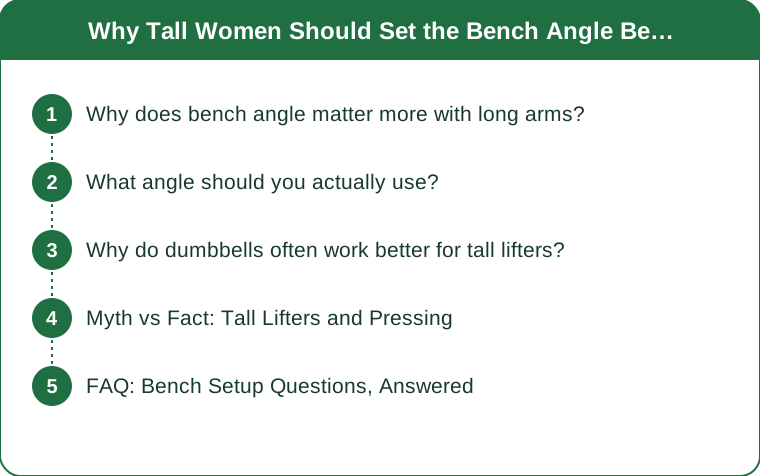
Why does bench angle matter more with long arms?
Because arm length multiplies both the range of motion and the leverage effects of the angle.
A longer humerus means the bar or dumbbells travel considerably further on every rep. More distance means more time under tension per rep, more total work, and more accumulated fatigue at a given weight. That is not a bad thing, but it means a long-limbed lifter is doing a different amount of work than a shorter lifter using the same load and set count.
Angle then determines which muscle does that work. At flat, the load is distributed across the sternal chest with modest front-delt involvement. As the bench inclines, the line of pull rotates upward and progressively shifts emphasis toward the clavicular chest and then the anterior deltoid.
With long arms, the shoulder reaches a more extreme position at the bottom of the movement at any given angle. So a 45 degree incline that is a solid upper-chest exercise for a shorter lifter can, for a long-limbed one, put the shoulder into enough extension that the front delt takes over and the chest contributes relatively little.
What angle should you actually use?
Shallower than the gym convention, and set by feel rather than by the sticker on the bench.
Most adjustable benches offer positions around 15, 30, 45 and 60 degrees. Research and practice both suggest that upper-chest activation is well served somewhere around 15 to 30 degrees, with front-delt involvement climbing sharply above 45.
For a long-limbed lifter, a practical approach:
Start at the shallowest incline available, often 15 degrees, and press a light set. Notice where you feel it.
Move up one notch at a time until you find the point where the chest sensation drops and the front of the shoulder takes over. That is your ceiling.
Train just below it. For many tall lifters that lands around 15 to 30 degrees rather than the 45 that is often the default.
The same logic applies in the other direction on a decline or flat bench, where long arms allow a deeper stretch than a shorter lifter gets. That deep position is valuable, and it is also where shoulder discomfort tends to appear, which makes dumbbells worth considering.

Why do dumbbells often work better for tall lifters?
Because they let the range of motion be yours rather than the bar’s.
With a barbell, the bar hits your chest at a fixed depth determined by your torso and arm length. For a long-armed lifter with a relatively shallow chest, that means the shoulders travel into significant extension at the bottom of every rep, which is where many people first notice discomfort.
Dumbbells let you stop at the depth that suits your shoulder. They also allow a slightly narrower, more natural path and let the wrists rotate, which relieves stress at the elbow and shoulder.
The trade-off is that dumbbells are harder to load heavily and harder to get into position. A reasonable compromise many tall lifters land on: dumbbells for incline work, barbell for flat, with the flat bench’s range managed by grip width. A slightly wider grip reduces the distance the bar travels and shortens the range at the shoulder.
One more option worth knowing: a floor press limits the depth mechanically and is a genuinely useful variation for anyone whose shoulders complain at the bottom of a press.
Myth vs Fact: Tall Lifters and Pressing
Myth: Tall people are just bad at pressing. Fact: Long arms mean a longer range of motion, so the same load represents more work. That makes the numbers lower at equivalent effort — it is a leverage difference, not a weakness.
Myth: A steeper incline works the upper chest harder. Fact: Beyond roughly 30 to 45 degrees, increasing incline mostly recruits more front deltoid, not more upper chest. Steeper is not more targeted.
Myth: You should touch your chest on every rep. Fact: Full range is generally valuable, but for a long-armed lifter the bottom position can put the shoulder into more extension than is comfortable. Dumbbells or a slightly wider grip give you the range your shoulder actually tolerates.
Myth: If your chest does not grow, you need more volume. Fact: If the load is going to your front delts, more volume gives you more front delts. Fix the angle first, then consider volume.
Myth: Bench settings are a detail. Fact: For a long-limbed lifter, the angle and the seat position change which muscle is trained. It is not a detail; it is the exercise selection.
FAQ: Bench Setup Questions, Answered
How do I know if my front delts are taking over?
The day-after soreness tells you. If the front of your shoulders is sore and your chest is not after an incline session, the angle is likely too steep for your leverages.
Should I adjust the seat as well as the back?
Yes. On an adjustable bench, a slight seat incline stops you sliding down, which otherwise changes your position mid-set and quietly alters the angle you carefully chose.
What about machine presses?
Machines are fixed to an average frame and are frequently a poor fit for long limbs, particularly at the seat and handle positions. Adjust the seat height so the handles line up with mid-chest rather than accepting the default, and if the machine cannot be made to fit, dumbbells will serve you better.
This is general information, not medical advice. Persistent shoulder pain during pressing warrants assessment by a qualified professional.
TL;DR:
- Long arms mean a longer range of motion, so the same weight represents more work — lower numbers are leverage, not weakness.
- Bench angle decides which muscle does that work, and steep inclines shift the load to the front delts on long-limbed lifters.
- Find your ceiling by climbing one notch at a time; many tall lifters land at 15 to 30 degrees, not 45.
- Dumbbells, a wider grip or a floor press let you set the depth your shoulder tolerates.
Set the bench for your body, then pick the weight. Doing it the other way round is how a chest exercise quietly turns into a shoulder one.
Keep Reading
This article is for general informational and styling purposes only. Fit, sizing, and product availability may vary.