Why Your Shorts Inseam Changes Everything When Your Legs Are Long
Quick Answer: Inseam is measured from the crotch down, so on a longer femur the same inseam ends higher up the leg as a proportion of total leg length. A 5-inch short that reads mid-thigh on a fit model reads considerably shorter on a longer leg, and a 7-inch that reads modest becomes a genuinely useful length. For most tall frames the practical range sits two to three inches longer than standard sizing assumes.
Stop shopping by the word short. Shop by the number.

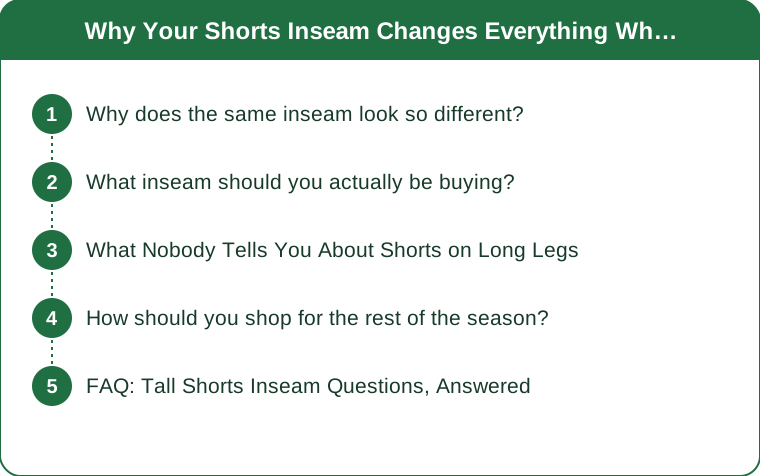
Why does the same inseam look so different?
Because inseam measures from a fixed point downward, and the leg it is measured on is not fixed.
Inseam is the distance from the crotch seam to the hem along the inside leg. It is an absolute measurement, and it says nothing about where the hem lands relative to your body.
Total leg length varies far more than inseam grading does. Brands add only a small amount of inseam per size step — often a centimetre or less — while the actual difference in femur length across the range of adult heights is many times that.
The consequence is a proportion shift:
A 5-inch inseam on an average frame sits around mid-thigh. On a longer thigh, the same 5 inches covers a smaller fraction of the leg and lands noticeably higher.
A 7-inch inseam, which reads long and modest in product photography, frequently reads as a standard mid-thigh short on a tall frame.
A 9 or 10-inch inseam, marketed as a bermuda length, often lands just above the knee rather than at or below it.
This is why tall women consistently report that shorts arrive shorter than expected, regardless of brand or price.
The rise interacts with it. A short with a rise that is too low sits below the natural waist on a long torso, which pulls the entire garment down and makes the hem land lower — sometimes concealing the inseam problem, sometimes creating a new one at the crotch.
And the leg opening compounds it. A short inseam with a fitted leg opening rides upward with movement, so the effective length is shorter still by the end of a walk.
What inseam should you actually be buying?
Two to three inches longer than the standard equivalent, and measured rather than guessed.
Measure your own reference first. Stand in front of a mirror, mark where you want the hem, and measure from the crotch to that point. That single number replaces every guess about a product description.
As a general translation for a taller frame:
For a genuinely short summer short, look at 5 to 6 inches rather than 3 to 4.
For an everyday mid-thigh short, look at 7 to 8 inches rather than 5.
For a longer tailored or bermuda short, look at 9 to 11 inches rather than 7 to 9.
For an athletic short you will actually move in, longer is generally better, and a fitted liner or slip short underneath removes the riding-up problem entirely regardless of the outer length.
Buy brands that publish inseam by size. A brand that lists a single inseam for a whole size range is telling you it does not grade length, which means the largest size has the same leg length as the smallest.
Check whether tall ranges include shorts at all. Many do not, because length is treated as a style decision. Tall trousers are common; tall shorts are genuinely rare, which is why the measurement approach matters more here than anywhere else in the wardrobe.
Consider buying a longer style and hemming. Hemming shorts is cheap and easy, and buying a bermuda to cut to mid-thigh gives you control of the exact length. The reverse is impossible.

What Nobody Tells You About Shorts on Long Legs
Proportion beats length. A slightly longer short with a higher rise usually looks better on a tall frame than a shorter one, because it balances the leg-to-torso ratio rather than exaggerating it.
The hem line draws the eye. Where the hem sits is where the leg visually breaks. A hem at the narrowest point of the thigh is the most flattering placement, and on a longer leg that point sits lower than the standard grading assumes.
Cuffed shorts lose about an inch. A rolled or cuffed hem shortens the effective length, and on a frame where every inch counts that is worth knowing before buying.
Fabric weight changes the read. A heavier woven hangs and holds its length; a lightweight fabric rides and clings, which makes the same inseam behave differently.
Side slits add movement without adding length. They allow the leg to move without the hem climbing, which is the practical problem with fitted shorts on long legs.
Athletic shorts and casual shorts follow different conventions. Athletic inseams are usually stated clearly; fashion brands often describe rather than measure, and the description is calibrated to the fit model.
High rise is your friend. A rise that reaches the natural waist on a long torso lengthens the visible leg line and keeps the whole garment where it belongs, which stops the hem migrating.
How should you shop for the rest of the season?
Late August is the moment when this becomes both easier and harder.
Clearance is live and extended sizing is disappearing. For summer shorts, this is the last realistic window. If you know your target inseam, buying now for next summer is genuinely good value, and it removes next year’s search entirely.
Autumn shorts are a real category. Longer tailored shorts worn with tights and boots have become a standard transitional look, and the longer inseams that suit a tall frame are exactly the ones that work layered.
Buy for the layered version. A short you will wear over opaque tights needs a slightly roomier leg opening, because the friction between fabrics makes riding up worse than bare skin does.
Denim shorts are worth buying long and hemming. A longer denim short cut to your measured length gives a result no off-the-peg option matches, and denim hems well.
Test the sitting position before removing tags. A short that works standing can be substantially shorter seated, and on a long thigh the change is larger. Sit, cross your legs, and stand up again in the fitting room.
Write the number down. Once you know your ideal inseam for each category — casual, tailored, athletic — online shopping becomes reliable rather than a lottery. This is the single habit that changes tall shopping most.
One seasonal caution: end-of-season sale stock is final sale at many retailers, and buying an unfamiliar brand without a published inseam at final sale is how wardrobes fill with shorts nobody wears. Buy by the number, or buy returnable.
FAQ: Tall Shorts Inseam Questions, Answered
What inseam should a tall woman buy?
Generally two to three inches longer than the standard equivalent — 7 to 8 inches for an everyday mid-thigh short rather than 5. The reliable approach is measuring where you want the hem and shopping to that number.
Why do shorts always arrive shorter than they looked?
Because product photography shows a fit model whose leg length is shorter than yours, so the same inseam covers a larger fraction of her leg. The number is accurate; the visual reference is not.
Do tall ranges include shorts?
Often not. Tall grading is usually applied to trousers, jeans, and sleeves, and shorts are frequently excluded because length is treated as a style choice rather than a fit dimension.
Should I buy long and hem?
Yes, if you can. Hemming is inexpensive and gives you the exact length, and it is the only way to reliably get a specific inseam when brands do not grade length.
TL;DR:
- Inseam is measured from the crotch down, so the same number lands higher on a longer leg.
- Add roughly two to three inches to the standard equivalent, and measure your own preferred hem point once.
- Rise and leg opening matter as much as inseam; a high rise and a hem with room stop the whole garment migrating.
- Buy summer shorts in the current clearance and longer tailored pairs for layering into autumn.
Measure from your crotch to where you actually want the hem. That one number ends the guessing.
Keep Reading
This article is for general informational and styling purposes only. Fit, sizing, and product availability may vary.